5 Solar Panel UK Hacks for Big Savings
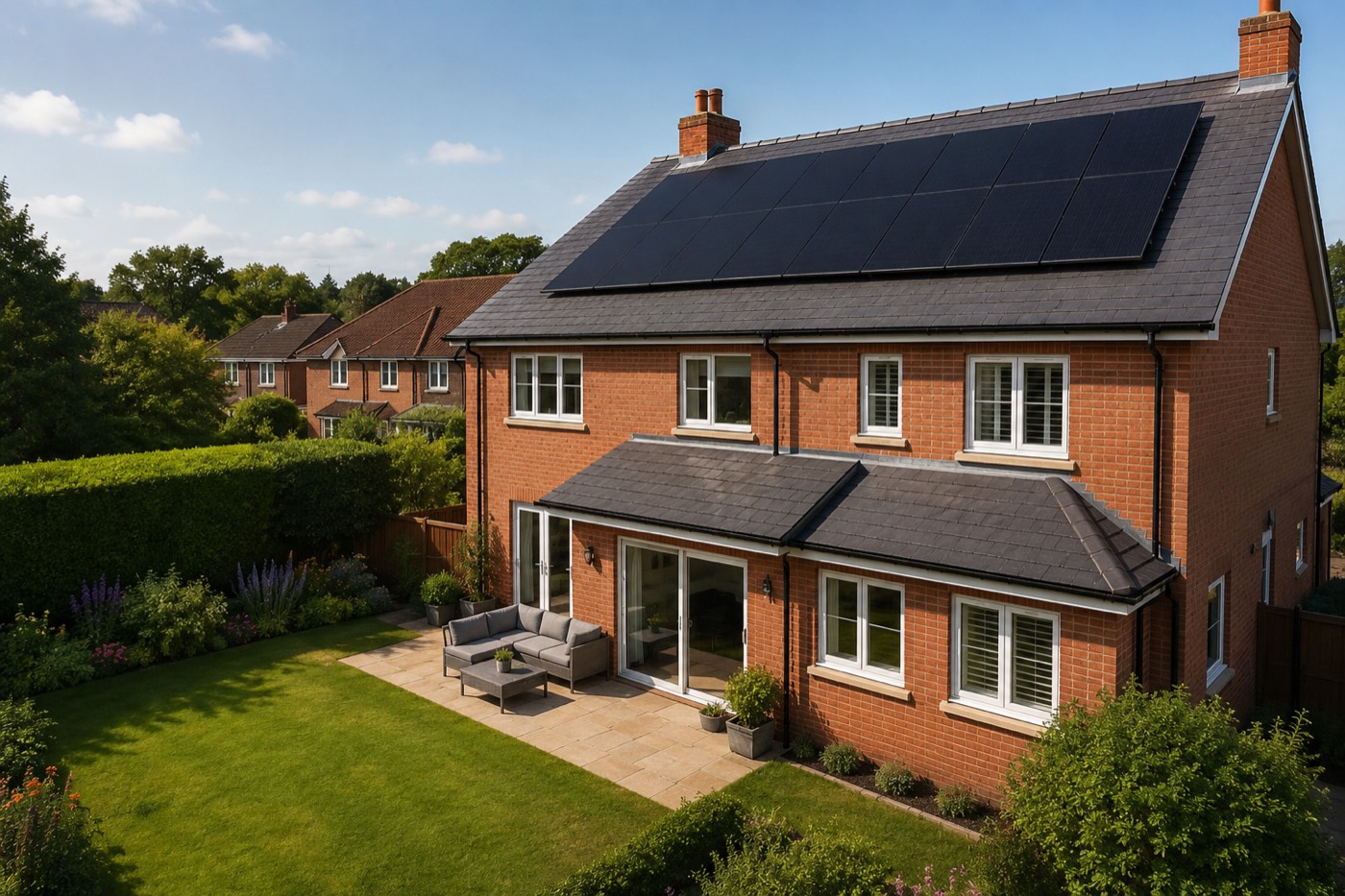
Solar panel arrays are appearing across British suburbs at record rates as households move to protect their budgets from volatile energy costs.
If you are like most British homeowners, opening your utility statements has become a deeply frustrating routine.
The April 2026 Ofgem price cap set a typical dual-fuel bill at £1,641 a year. From 1 July 2026 that cap rises 13% to £1,862, roughly £18 more a month, driven by higher wholesale gas costs. Your reliance on the traditional grid is a mounting financial liability.
To insulate your hard-earned savings, you need to change how your property sources its electricity. Hundreds of thousands of UK families are deploying solar systems to move away from this volatility.
The shift is accelerating: the UK passed two million solar installations in early 2026, and March 2026 was the busiest month for new installs since 2012, with more than 27,000 completed. However, making the wrong decisions during the design phase can compromise your long-term return on investment.
Key takeaways for UK homeowners
- Beat the July price rise: generating your own electricity protects your household from the confirmed 13% price cap increase that takes a typical bill to £1,862 from 1 July 2026.
- Capitalise on zero-rate tax: domestic solar panels, battery storage and professional installation are exempt from VAT (0% rate) until 31 March 2027.
- Demand certified trades: you can only register for Smart Export Guarantee (SEG) cash payouts if your entire system is signed off by certified installers.
The reality of solar generation architecture
A solar photovoltaic (PV) system works by absorbing daylight through specialised semiconductor cells, converting solar irradiance into direct current (DC) electricity. An indoor inverter then transforms this raw energy into alternating current (AC), seamlessly supplying your domestic sockets, lighting circuits and heavy appliances.
A common misconception among British property owners is that our famously overcast, grey weather prevents solar technology from delivering practical value. Modern high-efficiency panels do not require direct, unbroken Mediterranean sunshine to generate power. They operate effectively using diffuse ambient light, so they consistently produce clean electricity even during standard overcast British winter afternoons.
The underlying financial mechanics of a residential solar installation are governed by your domestic Self-Consumption Rate (SCR). This critical percentage represents the proportion of your generated solar electricity that is used directly within the home rather than exported back out to the national network.
If your system achieves an SCR of only 30%, you still buy the remaining 70% of your evening power from expensive grid suppliers. By integrating smart home scheduling or a physical battery storage system, you can lift your self-consumption past 80%, unlocking true utility independence.
Grid energy exposure vs. solar plus storage independence
| Operational metric | Standard grid supply only | Standalone solar PV system | Integrated solar + battery array |
|---|---|---|---|
| Typical annual electricity cost | Full grid price | Around 30% to 45% lower | Around 60% to 80% lower |
| Typical household self-consumption | 0% | 30% to 50% | 70% to 90% |
| Protection against tariff spikes | None (100% exposed) | Partial (daytime protection) | Near-complete (day & night protection) |
| Smart Export payout eligibility | None | Yes (SEG rates apply) | Yes (optimised tariff arbitrage) |
5 massive saving success secrets
1. Rejecting the subsidised "grant-first" illusion
Many homeowners delay their renewable transition because they are waiting for a comprehensive, fully government-funded free installation scheme. This is a critical strategic misstep. The real value of modern solar architecture lies in long-term grid independence, not short-term setup subsidies. With average equipment manufacturing costs falling substantially over the last two years, a premium installation delivers rapid, compounding cash savings from day one, making arbitrary grant delays financially counterproductive.
2. Sizing your system for your true evening load
An incorrectly specified solar array creates ongoing financial inefficiencies:
- Under-sized systems fail to produce enough raw energy to cover basic daytime appliance baseloads, leaving you reliant on utility imports.
- Over-sized standalone systems generate massive excess electricity during peak afternoon hours, which is dumped back onto the grid for minimal financial return, prolonging your payback window.
Experienced technicians analyse your historical utility data and half-hourly smart meter readings to calibrate your total kilowatt-peak (kWp) panel volume to match your lifestyle.
3. Ignoring the power of smart tariff arbitrage
Running your high-drain appliances blindly during peak evening hours destroys the economic return of your investment. Modern solar management involves pairing your panels and battery storage with automated, flexible time-of-use tariffs. By scheduling your domestic battery to charge from the grid at cheap off-peak night rates (as little as 7p to 10p per kWh on the best time-of-use tariffs) and using that stored energy during peak evening windows, you turn your system into an active money-saving asset.
4. Overlooking the crucial inverter configuration
The inverter is the computational brain of your renewable setup. Many companies cut corners by deploying basic string inverters on properties that experience partial shading from chimneys, trees or nearby dormer windows. If a single panel in a basic string is shaded, the performance of the entire loop drops to match that lowest performer. Using individual power optimisers or microinverters ensures every module operates independently, maximising your aggregate generation.
Standard string system: a single shaded panel drops the whole string's output to the minimum level.
Optimised solar array: the shaded panel is isolated, and the remaining panels keep running at 100%.
5. Using uncertified, non-MCS installers
Failing to verify the professional credentials of your installation team can cost you thousands over the life of your hardware. To unlock the Smart Export Guarantee (SEG) and receive legal cash payouts from energy suppliers for the clean electricity you feed back into the network, your system must be fully certified under the Microgeneration Certification Scheme (MCS). Cutting corners on cheaper, unaccredited labour completely locks you out of these statutory incentive programmes.
Moving beyond subsidies to true power security
While capital savings such as the 0% VAT relief, in place until 31 March 2027, provide a welcome financial cushion, the principal objective of upgrading your home is establishing complete energy security. The UK grid is facing sustained pressure, making standard fossil-fuel-linked electricity an increasingly volatile and expensive commodity for the modern homeowner.
By adopting solar configurations, you transform your roof into a decentralised power station. When you couple premium solar modules with advanced lithium iron phosphate (LFP) battery storage, you take command of your domestic overheads. Instead of worrying about political instability affecting global fuel markets, you produce, store and control your power directly on-site.
The connected resilience strategy: British properties integrating solar generation alongside smart battery management effectively insulate themselves from regional distribution network dropouts while maintaining predictable household running costs across all four seasons.
The matchmaker pivot: getting your installation right
Deciphering structural roof constraints, electrical inverter capacities and complex grid connection paperwork can quickly feel overwhelming. You do not have to navigate this engineering transition by yourself.
At Green Tide Energy, we take the complexity and stress out of your renewable project. We act as your expert matchmaker, connecting you directly with vetted, fully certified local MCS-accredited solar specialists who understand the structural nuances of UK housing stock.
Our trusted network of professional partners takes care of the entire process on your behalf. They manage the initial structural load assessments, perform detailed shade-mapping analysis, optimise your battery storage capacity and complete all the mandatory distribution network operator (DNO) grid notifications. This makes sure your system is safely commissioned for maximum output without any administrative friction.
Stop leaving your family budget exposed to unpredictable price hikes and looming market spikes. Secure your household energy independence with a high-performance, custom-engineered solar solution. Check if your home qualifies here.
Frequently asked questions
Do solar panels work in the UK's cloudy weather?
Yes. Modern panels generate from diffuse daylight, not just direct sun, so they produce electricity even on overcast British days. Output is lower in winter, which is where battery storage and smart time-of-use tariffs help you get the most from your system.
Is there still 0% VAT on solar panels and battery storage?
Yes. Domestic solar panels, battery storage and the professional installation are zero-rated for VAT until 31 March 2027, after which the rate is expected to return to 5%.
Do I need an MCS-certified installer to get paid for exported electricity?
Yes. To claim the Smart Export Guarantee and be paid by energy suppliers for the electricity you export, your system must be certified under the Microgeneration Certification Scheme (MCS). Uncertified installs are locked out of these payments.
How much can solar and battery storage save on my energy bills?
It depends on your home, system size, roof orientation and tariff. A well-sized solar and battery system can remove a large share of your grid import, especially when paired with a time-of-use tariff. An MCS-certified installer gives you an accurate, personalised estimate.